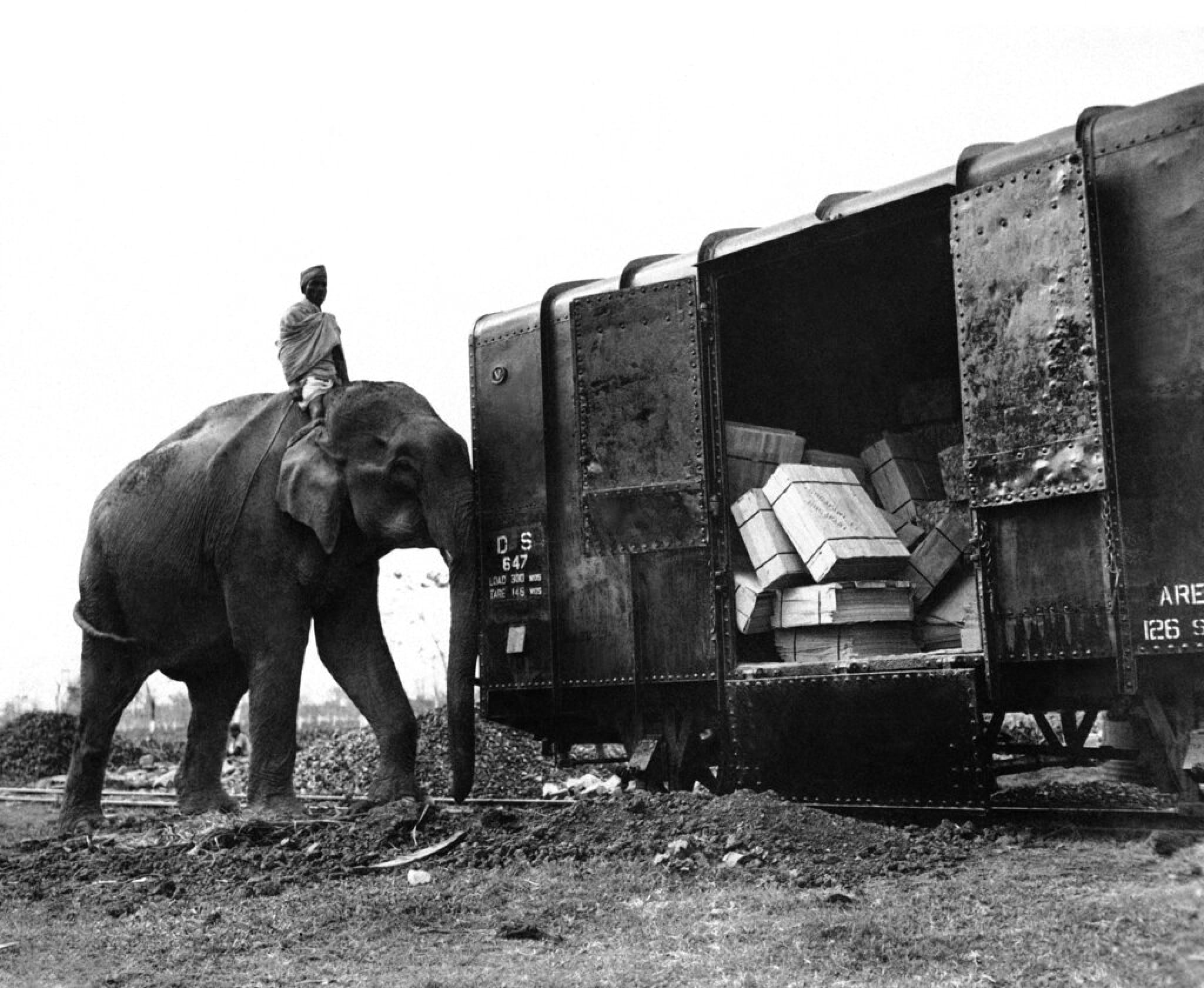
A boxcar, likely filed with tea for freight transport is loaded onto the track. The elephant is used to remove the need for a shunting engine. More about this practice can be learnt here: When elephants were on the payroll of Indian Railways – TOI
Even more interesting than the use of the elephants is the fact that this railroad was operated by the US Military Railway Service during their deployment in India during WW2:
In addition to Europe and North Africa, MRS units operated railroads in India, Burma, and the Philippine Islands. Railway units in India supported construction of the Ledo Road and the airfield used for the airlift over the Himalaya Mountains that provided logistical support to the Chinese. They also supported British and the American forces fighting the Japanese in Burma. The 705th Railway Grand Division (Southern Pacific Company) oversaw military rail operations in India and Burma. The division, along with five railway operating battalions, the 721st (New York Central Railroad), 725th (Chicago, Rock Island and Pacific Railroad Company), 726th (Wabash Railroad Company), 745th (Chicago, Burlington and Quincy Railroad), and 748th (Texas and Pacific Railway company) all sailed from Los Angeles aboard the SS Mariposa in December 1943. After thirty-one days at sea they arrived at Bombay, India, in January 1944 to begin operation of sections of the Bengal and Assam Railway.
In India, each of the five operating battalions managed an average of 133 miles of railway. By implementing American techniques, the tonnage carried by the Bengal and Assam Railway increased forty-six percent in the first twenty-six days after the MRS took over. Compared to American railroads, the Indian system was relatively primitive. A unique aspect of railroading in India was the use of elephants to switch cars when locomotives were not available. India also had little in the way of telegraph, telephone, or signal communications. American railroaders installed modern communications equipment to coordinate the increased train movements. They also added 100 miles of double track to facilitate traffic flow. The improvements paid off. Between February 1944 and September 1945, the MRS moved 6,217,143 tons of freight and operated 5,559 passenger trains. The last American railway units left India in October 1945.
Source: The Army Historical Foundation
Year
Source
Source Caption:
An elephant pushes a boxcar of the Bengal and Assam Railway in India on a tea garden siding at Bogapani near Ledo on May 19, 1945. This section of the railway is operated by the Military Railway Service of the U.S. Army. The elephant, 80 years old, can push several loaded cars, making it possible to do without a shunting engine at this siding. (AP Photo) May 19, 1945 6:30 AM